


70cm pre amp kit


Product Details
- 70cm pre amp kit
- VwBv2yW
- Weight: 750.0g
- Product Condition: New
- Units in Stock: 8
Product Description
A 70cm Pre-amplifier for mode V/U Satellite Reception David Bowman G0MRF
If you operate on VHF and above, you will already appreciate that a weak signal arriving at your antenna can be completely lost in the length of coax connecting the antenna to the radio. To mitigate this, and to improve your station’s receive performance, there are two popular solutions. One is to purchase some new low loss and usually very expensive coax or, to fit a low noise amplifier ( LNA ) close to the antenna. Until recently, the go-to person for pre-amplifier kits was Sam Jewell, G4DDK. These days, Sam spends his time in the shack operating the radio rather than packing kits. He has however, generously allowed a modified version of his PGA432 design (1) to be produced by AMSAT-UK. At the heart of this 70cm pre-amp is a Mini-Circuits PGA-103 monolithic amplifier (2). This device is internally matched to 50 ohms in and out and can operate from 50MHz to 4GHz. At 400MHz it has a low noise figure of 0.55dB with a gain of 22dB and a P1dB gain compression point of 21.2dBm which is over 100mW. While all this sounds ideal, in practice such a wideband device can amplify unwanted signals and cause receiver overload. Consequently, if you use a wide bandwidth amplifier, it’s good practice to add some filtering to remove the unwanted frequencies. This is particularly true for mode V/U satellite operating, where you are trying to receive a weak signal on 70cms, but at the same time transmitting a large signal on 2m from an antenna just a couple of metres away.
Circuit Description.
The circuit diagram is shown in fig 1. The input signal is applied to N-type connector J1 where it passes through a high pass filter comprising C1, L1 and C2. In addition, C3 and L2 form a high Q series tuned notch filter tuned to the 2m band. This attenuates the uplink signals at 145MHz by over 30dB. A Spectrum analyser plot showing the depth of the notch is shown in fig 2.
On the output side of the PGA-103 amplifier, the signal is AC coupled by C5 to the low pass Chebyshev filter C7, L4 and C8 which has a cut–off around 470MHz. The combination of the input and output filters produce a bandpass filter effect with plenty of gain at 70cms while reducing the gain to 0dB gain at 179 and 595MHz. Finally, a 3dB attenuator R1 R2 and R3 reduces the overall gain on 70cms down to 16dB, which is sufficient to overcome losses in coax, without the risk of overloading your receiver. The PGA-103 operates from a 5V supply provided by U1, a 78M05 linear voltage regulator. A pad is provided on the PCB at the input of U1 should you want to power the pre-amp directly. Alternatively, a more convenient method is to provide power via the coax and many radios, the IC9700 included, now include this feature as standard. The RF signal is coupled the output connector by C11. The DC voltage to power the amplifier arrives from the radio via the coax and is fed to the 5V regulator U1 via the RF choke L5. The PGA-103 requires around 84mA at 5V.
Conclusion
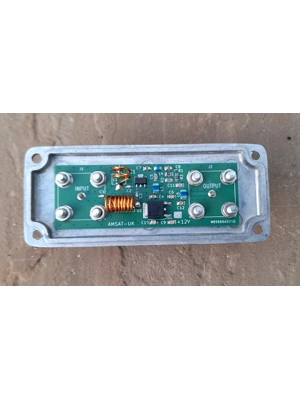
This project was inspired by my attempts to work stations on RS-44. Despite using various filters in the 2m and 70cm coax feeders, I always experienced some degree of breakthrough from the 2m signal. However, when I tested the prototype of this design late one evening on RS-44, I was running 40W of 2m and was delighted to work Jerry W8LR, PD4HDB and N1IPA without a trace of interference. The use of the filters does have a small cost in the overall noise figure. Sam’s original design had a noise figure of 0.75dB while a typical example of this design, with no optimisation was measured at 1.0dB The completed pre-amplifier PCB has only 20 components and is shown in fig3 and fig4.
Kits including the diecast box and N connectors will be available directly to members via the AMSAT-UK shop, or to non-members via [email protected] (1) http://www.g4ddk.com/Products.html (2) https://www.minicircuits.com/pdfs/PGA-103+.pdf?